


Collection of Authentic Ancient Judean Bronze Coins (1st Century BCE - 1st Century CE) in Engraved Olive Wood Box
Collection of Authentic Ancient Judean Bronze Coins (1st Century BCE - 1st Century CE) in Engraved Olive Wood Box
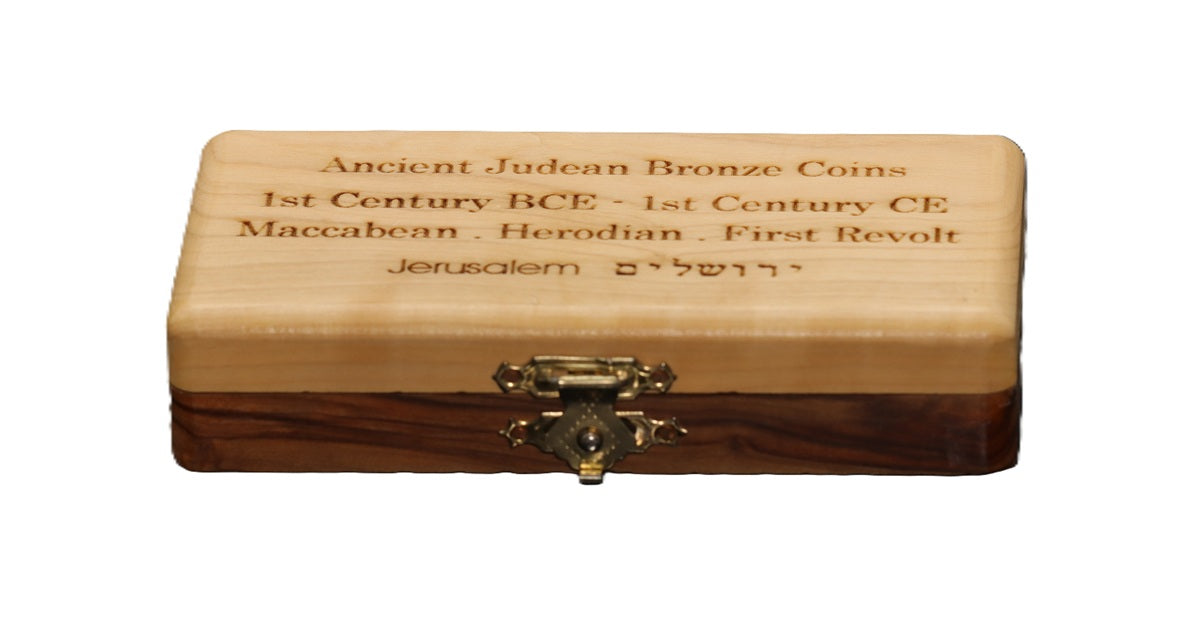
Collection of Authentic Ancient Judean Bronze Coins (1st Century BCE - 1st Century CE) in Engraved Olive Wood Box Description: A remarkable collection offering a tangible connection to the Holy Land during the time of Jesus and the Second Temple period. This unique set comprises multiple authentic bronze coins, primarily prutahs and lepta, that circulated in Judea during a period of immense historical and biblical significance, spanning approximately 135 BCE to 70 CE. These coins were minted by Jewish rulers under Hasmonean and Herodian dynasties, as well as Roman prefects, in Jerusalem. -Historical Context: These are the types of coins used for everyday commerce in Judea. Some of the smaller, low-denomination pieces are commonly referred to as "widow's mites," referencing the biblical story in the Gospel of Mark (Mark 12:41-44) where Jesus commends a poor widow for donating all she had. Variety of Rulers and Eras: The collection includes various types of coins from different rulers of the era: -Maccabean/Hasmonean: Coins likely feature common symbols like the anchor, star, double cornucopia, or palm branches, often with Paleo-Hebrew inscriptions. -Herodian Dynasty: Coins minted under Herod the Great or his successors may feature symbols like the tripod or anchored ship. -Roman Procurators/First Revolt: Later coins may feature less Jewish-specific Roman imagery or symbols of resistance like amphorae or vine leaves from the Jewish Revolt period. -The collection has Five Coins : First two Coins: Valerius Gratus (Roman Prefect of Judaea) under Emperor Tiberius (14–37 CE). Obverse (Top Image): The obverse likely depicts a vine leaf on a branch, as the inscription "IOYΛIA" (Julia), referring to Livia (Emperor Tiberius's mother), is usually associated with a vine leaf or three lilies motif on Gratus' coins. Reverse (Bottom Image): The reverse appears to be a Kantharos (a deep, two-handled drinking cup with scroll handles), or possibly a narrow-necked amphora, with the inscription "KAICAP" (Caesar) above and a date in the field. This specific type was minted around 17 CE. - Second Coin: Herod Agrippa The term "Herodian" refers to the dynasty that ruled Judaea as a Roman vassal state from 37 BCE to 92 CE, founded by Herod the Great. The coinage of this dynasty is a diverse category of ancient Jewish coins. The specific coin type shown in the previous images is a common prutah issued by Herod Agrippa I, the grandson of Herod the Great, who ruled from 37–44 CE. It is one of the most popular types of Herodian coins for collectors. Description of the Coin: Ruler: Herod Agrippa I (37–44 CE). Date: Issued in the 6th regnal year (dated "LϚ" in Greek), corresponding to 41–42 CE. Mint Location: Jerusalem. Obverse (Top Image): Features a royal, fringed, umbrella-like canopy (kibotos), a symbol of Agrippa's monarchical authority, surrounded by the Greek inscription "ΒΑCΙΛΕWC ΑΓΡΙΠΑ" ("of King Agrippa"). Reverse (Bottom Image): Depicts three ears of barley, a traditional Judaean symbol of agricultural abundance and a blessing of the land. The regnal year is inscribed in the field. -Third Coin : A rare Pontius Pilate prutah coin from the time of Jesus Christ, housed in a handcrafted olive wood box from the Holy Land. This set features an authentic bronze Roman coin issued by the Roman Prefect of Judaea, Pontius Pilate, in 29 A.D., the 16th regnal year of Emperor Tiberius. Historical Significance: Pontius Pilate is a pivotal figure in the New Testament, known for his role in the trial and crucifixion of Jesus. This exact type of coin would have circulated in Jerusalem during that era. Coin Details: -Obverse: The coin features the inscription "IOYΛIA KAICAPOC" (Julia Caesar/Augusta), referring to Livia, the mother of Emperor Tiberius, and three bound ears of barley. -Reverse: It displays a simpulum, a Roman religious libation ladle, surrounded by the inscription "TIBEPIOY KAICAPOC" (of Tiberius Caesar) and the date LIς (Year 16). The last Three Coins " widow's mite " Coins: -Widow's mite coins : Alexander Jannaeus was the first of the Jewish Kings to introduce the “eight-ray star” or “eight-spoked wheel” symbol in his bronze “widow’s mite” coins, in combination with the wide-spread seleucid numismatic symbol of the anchor. These coins are thought to be the ones referred to in the Bible in Luke 21:14 And Jesus sat over against the treasury, and beheld how the people cast money into the treasury; and many that were rich cast in much. And He called unto him. His disciples, and saith unto them, Verily I say unto you, that this poor widow hath cast more in, than all they which have cast into the treasury: For all they did cast in of their abundance; but she of her want did cast in all that she had Depending on the make, the star symbol can be shown with straight spokes connected to the outside circle, in a style rather indicative of a wheel. On others, the spokes can have a more “flame-like” shape, more indicative of me representation of a star within a diadem. It is not clear what the wheel or star may exactly symbolize, and interpretations vary, from the morning star to the sun or the heavens. Presentation Box: The entire collection is housed in an elegant, handcrafted olive wood box sourced from the Holy Land. The lid is engraved with the collection's name in English and Hebrew ("ירושלים" - Jerusalem), creating a ready-to-display historical set. Authenticity: Each coin is a genuine ancient artifact, no two are exactly alike, with variations in wear and patina reflecting over 2,000 years of history.
Couldn't load pickup availability

-
#1 Choice for Holy Land Jewelry
Our quality is like no other - luxurious! -
Money-back guarantee
To ensure your satisfaction - or your money back. -
Worldwide Shipping
From the heart of Jerusalem to your doorstep!
Product Details
CUSTOMERS ALSO BOUGHT
-
Ancient Jewish Freedom of Zion Masada Coin Set in 14K Gold Decorated Pendant
Regular price $2,420.00Regular priceUnit price per -
18K White Gold and Diamonds Salsa rings
Regular price $4,400.00Regular priceUnit price per -
18K White Gold and Diamonds Salsa Bracelets
Regular price $12,800.00Regular priceUnit price per -
18K White Gold and Diamonds Salsa Earrings
Regular price $4,100.00Regular priceUnit price per


